
Registering a Dutch car in Spain, from export papers to Spanish plates
Importing a car from the Netherlands to Spain follows fixed steps: export deregistration with us, the ITV inspection, the registration tax and the application at Tráfico. Here is each step with the documents, the official costs and the deadlines.
- Export documents from €50
- Every Spanish step explained
- Deadlines and fees with sources
from €50

Registering a car from the Netherlands in Spain happens in two stages, and the second cannot start before the first is finished. First the car leaves the Dutch register: we take care of that at our RDW-recognised export desk in Hengelo. Then comes the Spanish registration, known as matriculación ordinaria, which the new owner applies for personally or through a gestoría.
This page brings together what the Spanish traffic authority DGT, the Spanish tax agency (Agencia Tributaria) and the official state gazette (BOE) say about each step, with the documents, fees and deadlines. It does not replace advice from a professional in Spain, but it helps you arrive at every appointment with the right paperwork.
Step 1: deregistering the car for export in the Netherlands
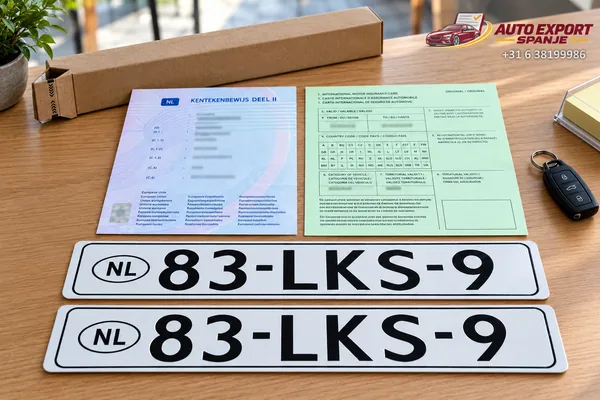
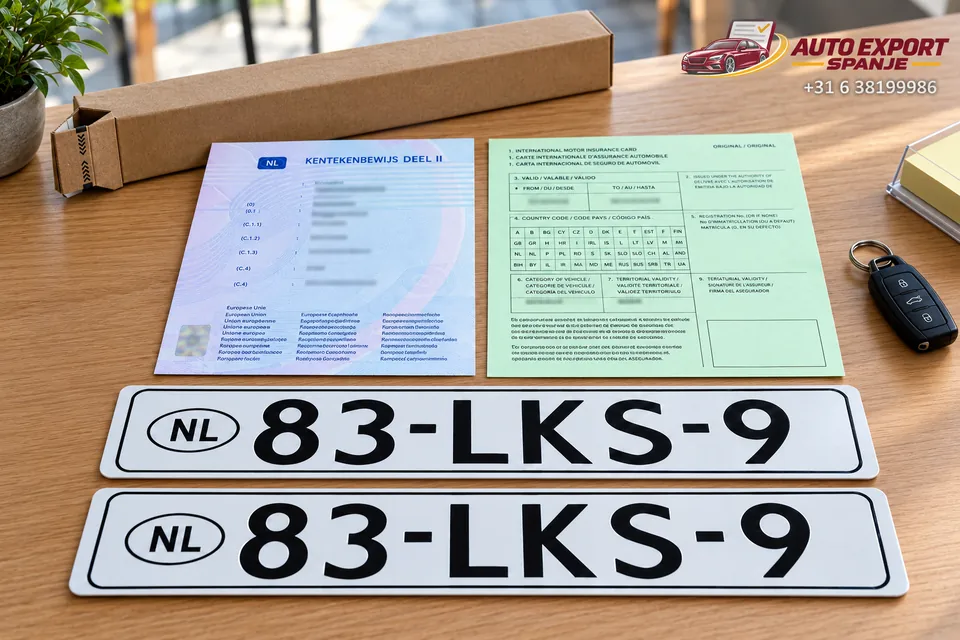
The DGT is clear that a vehicle must be deregistered for export in its country of origin before it is brought to Spain. At our desk, whoever the export is registered to receives the export certificate (kentekenbewijs deel II) and the registration card with one corner cut off; the seller receives the indemnification certificate. The RDW says the export certificate and the registration card together are what you need to register the car abroad.
With complete papers, this usually takes about 15 minutes at the desk. What to bring and what you receive is listed on Dutch car export documents. The RDW recommends checking first which documents the importing country requires, and only then deregistering. Is the car already in Spain? We can still deregister it, remotely, through a separate procedure that runs entirely by post with DHL delivery.
Step 2: the journey south on export plates or by transporter
If the car is driven, it gets Dutch export plates and temporary export insurance for 14 days with a Green Card. In the Netherlands you may drive for 14 days after deregistration, never beyond the expiry of the APK, the Dutch roadworthiness test.
Abroad, the RDW says the rules differ per country, so check what applies in France and Spain before you leave. The DGT allows driving on temporary plates from the country of origin while they are valid and the vehicle is insured. If registration takes longer than planned, you can extend the export insurance, 14 days at a time. On a car transporter, the car usually needs no driving insurance, but it does need the export document.
Step 3: ITV inspection and the Spanish technical card
In Spain, the car first goes to an approved ITV station for the pre-registration inspection. This is a separate type of inspection from the periodic ITV. Take with you:
- the foreign registration papers, which for a Dutch car means the registration card and the export certificate;
- proof of type approval: the CoC, a ficha reducida (according to the DGT, an engineer's document equivalent to the CoC) or, for cars from before 2002, an individual type approval;
- the purchase contract or invoice, if the new owner is not named on the registration papers.
The station then issues the technical card in Spanish format, the tarjeta ITV. If the CoC is missing, start early: this is the step that most often causes delays. On request we offer CoC support; the route differs per manufacturer and importer.
Step 4: registration tax IEDMT, road tax IVTM and other taxes
The registration tax is called IEDMT (Impuesto Especial sobre Determinados Medios de Transporte). It is declared to the Agencia Tributaria on form 576 if tax is payable, or on form 05 or 06 for an exemption or non-taxable vehicle. In the Basque Country and Navarre, the regional tax office handles it. The rate depends on official CO2 emissions. This is the standard rate for mainland Spain and the Balearic Islands, where the region has not set its own:
| CO2 emissions | Standard IEDMT rate |
|---|---|
| up to and including 120 g/km, and fully electric | 0 percent |
| above 120 and below 160 g/km | 4.75 percent |
| from 160 and below 200 g/km | 9.75 percent |
| from 200 g/km, or emissions not shown | 14.75 percent |
The Canary Islands have lower rates. The tax is charged on the market value from the Spanish tax tables for 2026 (Orden HAC/1501/2025): a new price multiplied by a percentage for age, for example 47 percent at 4 to 5 years and 10 percent at over 12 years. For a car previously registered abroad, a further deduction applies.
The owner also pays the annual road tax IVTM to the municipality where they live, and that must be settled before registration. If the car counts as new for VAT (under 6 months or no more than 6,000 km), VAT is due in Spain. Buying from a private seller means the transfer tax ITP and a purchase contract with a Spanish translation.
Step 5: registration at Tráfico, Spanish plates and insurance
You apply at the Jefatura Provincial de Tráfico for the province where you live, by appointment (cita previa, online or by phoning 060) or online through the DGT's electronic office (Sede Electrónica). Companies must apply electronically. You can be represented with a signed authorisation. You will need, among other things:
- the application form and identification with an address in Spain (for example a passport with an NIE number);
- the tarjeta ITV from the inspection station;
- proof of the IEDMT and the IVTM;
- the original Dutch registration papers and the purchase contract or invoice;
- the paid DGT fee (tasa 1.1): 99.77 euro, according to the DGT.
If the car has never been registered in Spain, it receives a new Spanish registration number and a registration certificate, the permiso de circulación. You then have the number plates made at a specialist shop and take out compulsory Spanish insurance.
Deadlines and processing time for registration in Spain
- One month: anyone who becomes resident must register the car within one month, according to the government portal. If that is not possible, temporary registration with green plates (placas verdes) is available, valid for 2 months and renewable.
- 30 or 60 days: if registration is not applied for within 30 days of the car's use in Spain beginning, the use itself becomes taxable. With the relocation exemption, the limit is 60 days.
- Up to 3 months: the legal maximum for the DGT to decide on an application.
There is no official average processing time. With complete papers (CoC included, value as per the tables), the Spanish part often takes a few weeks in practice, depending on appointments at the ITV station and Tráfico. That is an indication, not a promise. If you want to reclaim Dutch BPM, remember the car must be registered in Spain within 13 weeks of export.
Common mistakes when importing a car from the Netherlands
- Buying without a CoC and only finding out at the ITV station.
- No Spanish translation of a private purchase contract.
- Letting the 30-day or one-month deadline slip, with a tax bill as the result.
- Driving without valid cover once the export insurance has run out.
- No copies of the Dutch papers that Tráfico keeps.
Moving with your own car? You may qualify for an exemption from the registration tax: see moving to Spain with a car.
The cost of importing a car to Spain
With us, export documents cost from €50, export insurance with white plates from €100 and the complete package from €150. In Spain you add the DGT fee, the ITV inspection, possibly a ficha reducida or a gestoría, the IEDMT and the IVTM. All amounts are on the cost of importing a car to Spain.
| Service | Included | From |
|---|---|---|
| Export document | Export certificate, vrijwaringsbewijs (indemnification certificate) and RDW processing | €50 |
| Export insurance + white plates | 14 days liability cover, Green Card and white export plates | €100 |
| Complete export package | Export document, vrijwaringsbewijs, 14 days liability cover, Green Card and plates | €150 |
| Export insurance extension | 14 extra days of liability cover with a Green Card, requested online (per 14 days) | €120 |
When can the price be higher?
- All amounts are starting prices, including VAT where applicable.
- A surcharge may apply outside office hours. Office hours: Monday to Saturday 10:00 to 16:30. On Sundays you are welcome by appointment, at a higher rate; call or WhatsApp first for the final price.
- Postal delivery costs more; the same postal rate applies to the Netherlands and abroad.
- The price can differ per vehicle, for example for heavy or non-standard vehicles.
- You always know the price in advance.
All rates, including postal delivery, caravans, trailers and custom work, are on the page Prices and costs for Spain.
Exporting today?
Call or message us for free advice or an appointment, also outside office hours. On Sundays a higher rate applies; you always know the price in advance.
Questions about registering an imported car in Spain
What exactly is a ficha reducida?
According to the DGT, it is a document signed by a qualified engineer that is equivalent to the certificate of conformity (CoC). ITV stations accept it as proof of type approval when there is no CoC, and the DGT says it is often quicker and cheaper. Cars built before 2002 need an individual type approval by an engineer instead.
How much registration tax will I pay on an imported car?
It depends on the official CO2 emissions and the value. The standard rate is 0 percent up to and including 120 g/km, 4.75 percent below 160 g/km, 9.75 percent below 200 g/km and 14.75 percent from 200 g/km. The value of a used car comes from the Spanish tax tables. Regions may set their own rates, and the Canary Islands have lower ones.
Is Spanish VAT due on a used car bought in the Netherlands?
Only if the car counts as new for VAT purposes: less than 6 months since it was first put into service, or no more than 6,000 km. In that case VAT is due in Spain, even for a private buyer. If you buy an ordinary used car from a private seller, Spain charges the transfer tax ITP instead.
Do I have to use a gestoría for the registration?
No, it is not compulsory. The DGT notes that registrations are often handled by a dealer or a gestor, but you can also apply yourself. A gestoría can save time if you are not familiar with the language or the procedure.
Does Tráfico keep my original Dutch papers?
Yes. For a car from another EU country, Spain asks for the original registration documents, parts I and II, which for a Dutch car means the registration card and the export certificate, and retains them on registration. Keep them safe and make copies first; a copy alone is not accepted.
How long can a resident keep driving on Dutch plates?
According to the Spanish government portal, anyone who becomes resident in Spain must register the car within one month, and the Spanish tax agency states that residents may not drive on foreign plates. Different rules apply to people who are only staying temporarily, so check your own situation locally.
Official DGT, tax agency and BOE sources on registration
- DGT: Matricular un vehículo proveniente de la UE
- Sede Electrónica DGT: Matriculación de vehículos nuevos y vehículos provenientes del extranjero
- BOE: Ley 38/1992 de Impuestos Especiales (impuesto de matriculación)
- Agencia Tributaria: Modelo 576: instrucciones
- BOE: Orden HAC/1501/2025: precios medios de venta de vehículos 2026
- Punto de Acceso General: Matricular un vehículo proveniente de la UE en España
Checked on 1 November 2026